

Those first few minutes after something goes wrong can feel chaotic. People talk over one another, look around for someone who “knows what to do”, and precious time slips by. You might be in an office, on a farm, at a lodge, on patrol, or out in the bush – in all of these places, your first actions can make a real difference to the outcome.
You do not have to be a paramedic to help. You do, however, need a simple structure in your head and enough practice to fall back on it under pressure.
A Simple Way To Think About Any Emergency
Most emergencies – medical, wilderness, or security-related, can be approached in the same basic order:
- Check for danger
- Check response and breathing
- Call for help
- Do the few basic things you know how to do well
On paper this looks obvious. In real life, with shouting, blood, or fear in the air, it is easy to skip steps or do them in the wrong order. Good training is about building habits so that this sequence becomes automatic.
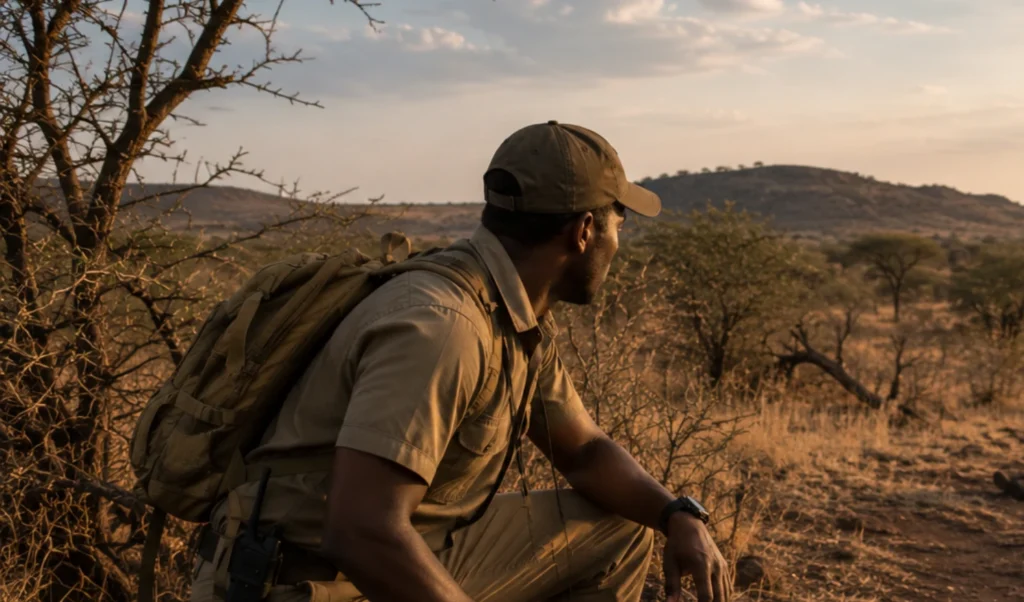
Start With Safety – Check for Danger
The first instinct for many people is to rush straight to the injured person. It feels caring, but it can be risky. In any emergency, the first responsibility is to make sure you do not become a second patient.
That means pausing for a moment to look for live electricity, fuel, smoke, fire, moving traffic, aggressive animals, a weapon, or unstable structures. In a security incident, you also need to consider if it is safe to approach at all, or if you should hold back, seek cover, and call for help.
Scene safety is a core idea in first aid, wilderness first aid, and security-focused training. A short pause to scan your surroundings can prevent a bad situation from turning into a disaster.
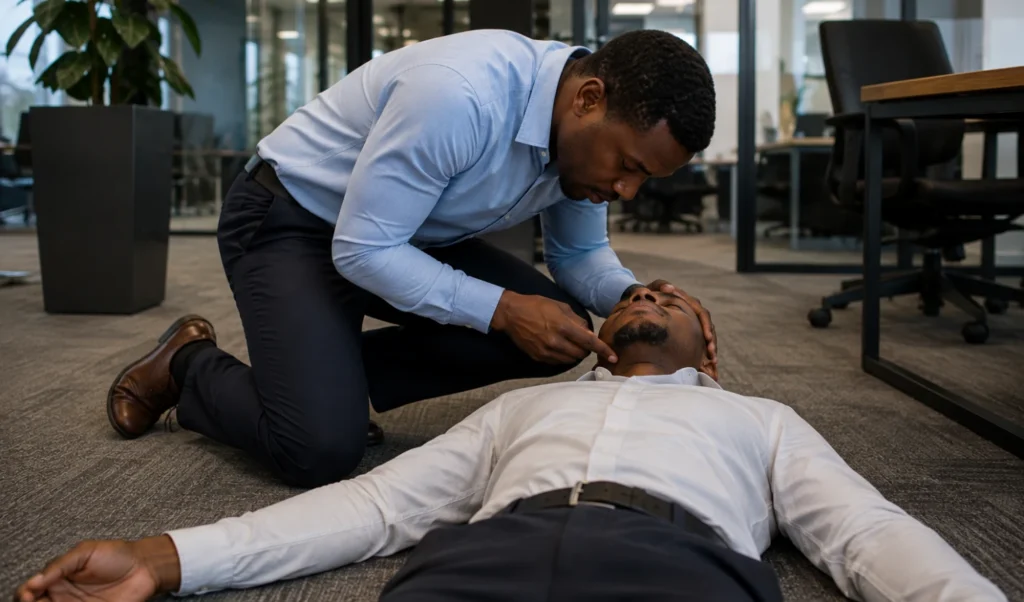
Check Response and Breathing
Once you are reasonably sure the area is safe, attention turns to the person on the ground. You want to answer two questions quickly: Is this person responsive? Are they breathing in a normal way?
An unresponsive person who is not breathing, or whose breathing is abnormal, faces an immediate threat to life. This is the moment for CPR and rapid activation of emergency services. A person who is breathing but not fully awake may need help to keep the airway open and constant monitoring. Someone who is awake but in pain or distressed needs to be kept still, calm, and talking while you assess what might be wrong.
These are simple concepts, but they are hard to apply in the moment if you have never practised them. In structured training, people repeat these checks again and again until they flow naturally: speak to the person, tap the shoulder, look at the chest, listen and feel for breathing.
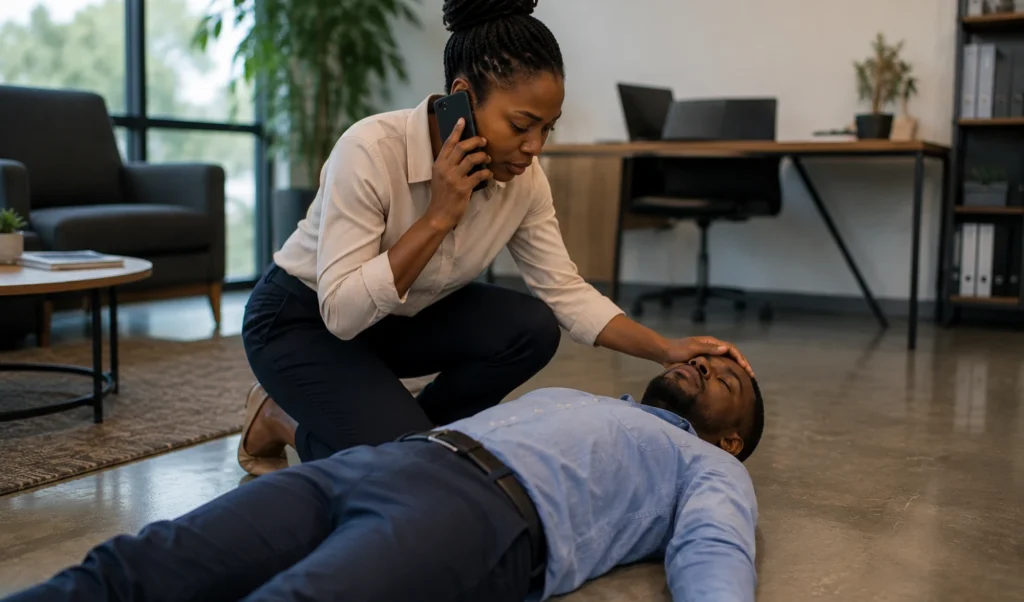
Calling for Help Properly
“Call an ambulance” sounds straightforward, yet in many incidents the call is delayed or the person on the phone struggles to explain what is going on.
Clear information speeds everything up. The person taking your call needs to know exactly where you are, what has happened, how many people are injured, the person’s level of consciousness and breathing status, and any ongoing dangers that might affect the response.
In remote or wilderness settings, there is an extra layer: who will meet the ambulance at the gate or road, what type of signal or radio contact is available, and how difficult it will be to move the patient from the scene. These questions are easier to answer if teams have spoken about them beforehand and emergency plans are part of routine briefings.
Good first aid and security training makes this kind of communication part of practice scenarios, not just theory on a slide.
Only Do What You Know
In the first five minutes, you are not trying to diagnose rare conditions or perform advanced procedures. Your focus is to stop the situation from getting worse.
In almost every emergency, the priorities are similar: keep the airway clear and the person breathing, control heavy bleeding, protect the spine if you suspect a serious fall or collision, and keep the person warm or cool as needed, still, and reassured until help arrives or evacuation begins.
The things you avoid matter just as much. Guessing with medication, moving someone with a possible neck or back injury for no good reason, cutting snake bites, applying the wrong creams or substances to burns, or forcing food and drink on someone who might need surgery can all do harm. Up-to-date first aid and wilderness first aid training replace old myths with current best practice.
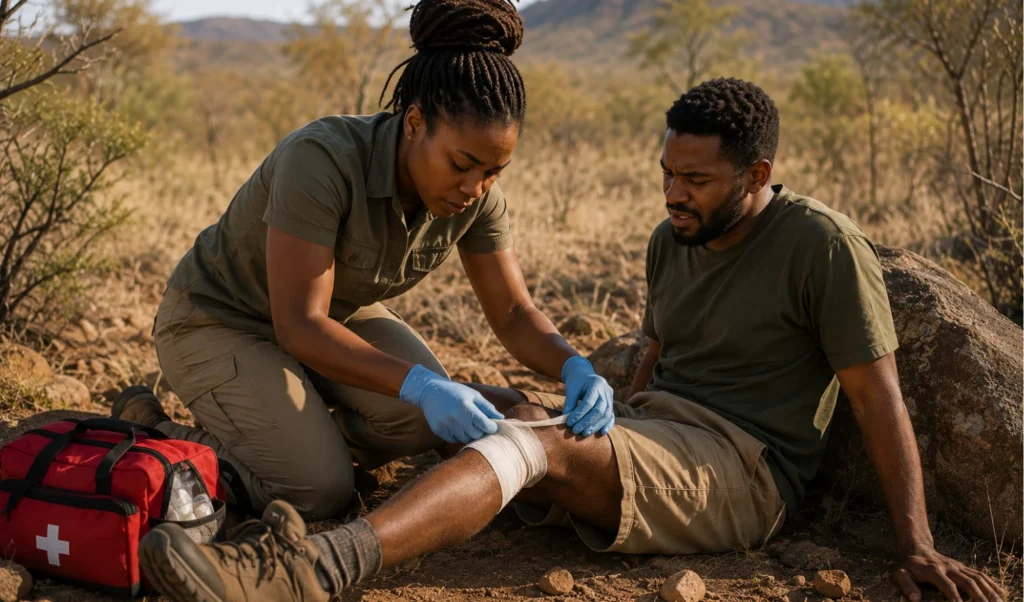
Why Practice Matters More Than Reading
Frameworks like “check for danger, response, breathing, call for help, basic care” read well and make perfect sense when you are calm. In real emergencies, your heart rate climbs, your hands may shake, and your thinking narrows. People tend to fall back on whatever they have practised recently and often.
That is why realistic training – not just watching, but doing – is so important. Practising CPR on a manikin, rehearsing how you would manage a fracture, simulating a scene in the bush with limited equipment, and role-playing the emergency call all build confidence. When something real happens, you are not starting from zero.
Being Ready in Any Environment
The basic pattern of the first five minutes does not change much between an office and a game reserve. The surroundings do. In the wilderness, you might have long transport times, rough terrain, limited communications, and changing weather to manage on top of the injury or illness. In a security incident, you might need to think about an ongoing threat at the same time as you provide care.
For staff on farms, at lodges, in security companies, on construction sites, or out in conservation areas, having people on the team who can handle those first minutes calmly is part of working responsibly. Guests, colleagues, and clients naturally assume that if something goes wrong, someone will know what to do. That “someone” is usually the person who has taken training seriously.
How SSG Training Fits In
SSG Training’s first aid and wilderness first aid courses are built around this kind of real-world decision-making. The aim is not to turn people into medics, but to give them a clear structure for those critical first minutes and the practical skills to back it up.
By combining theory with repeated, scenario-based practice in South African conditions – offices, sites, farms, lodges, and bush environments – SSG helps teams move from panic to purposeful action in the first five minutes of an emergency, when calm, confident decisions matter most.
